
Short Answer: Custom Formulation vs. Private Label
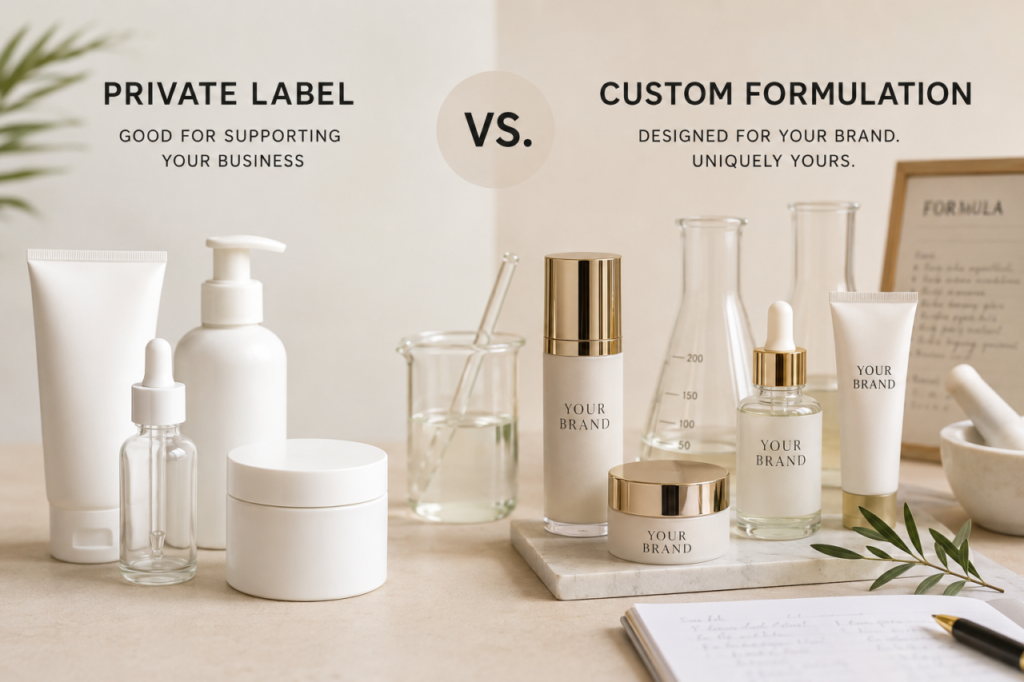
Private label is usually best when a product line supports an existing service business, such as a spa, salon, or med spa. Custom formulation is usually better when the product is central to the brand and needs unique performance, positioning, and exclusivity.
If you are building a long-term beauty brand, custom formulation gives you more control over texture, claims direction, ingredient choices, customer experience, and differentiation. If you simply need a branded retail add-on, private label may be enough.
Quick Comparison: Custom Formulation vs. Private Label
- Private label: faster to start, usually simpler, but less differentiated.
- Custom formulation: more strategic, more brand-specific, and better for exclusive product lines.
- Private label works best when the product supports another service.
- Custom formulation works best when the product is the reason customers buy from you.
- AMR Labs can help make custom formulation more guided through our product development process.
One of the first decisions a beauty brand has to make is whether to use a private label product or create a custom formulation.
At first, private label can seem like the easier option. The formula already exists, the development process appears simple, and the brand can usually get to market without starting from scratch.
Custom formulation, on the other hand, can sound intimidating. Many founders assume it automatically means high development costs, high minimum order quantities, long lead times, and a complicated process that will take too much of their time.
In reality, the right choice depends on what role the product is supposed to play in your business.
A simple way to think about it is this:
Private label can make sense when products support the business. Custom formulation is usually the better choice when the product is the business.
What Is Private Label?
Private label products are pre-existing formulas that a manufacturer already has available. A brand chooses from those existing formulas, selects packaging, adds its label, and sells the finished product under its own brand name.
This can work well in certain situations. For example, a spa, salon, med spa, or service-based business may want a small product line to use during treatments and sell at the front desk. In that case, the business is not necessarily trying to become a major skincare or haircare brand. The products are there to support the client experience, increase professionalism, and create an additional retail opportunity.
For those types of businesses, private label may be practical.
The issue is that many beauty brands choose private label because they think custom formulation is out of reach — not because private label is actually the best fit for their long-term goals.
What Is Custom Formulation?
Custom formulation means the product is developed specifically for your brand. Instead of choosing a stock formula that may be available to other companies, the formula is created around your goals, preferences, performance expectations, target customer, texture, scent, ingredient direction, and packaging needs.
At AMR Labs, custom formulation can include decisions around:
- Texture and skin feel
- Color and appearance
- Fragrance or fragrance-free direction
- Ingredients to include or avoid
- Product claims and positioning
- Packaging compatibility
- Market expectations
- Brand identity
This matters because a beauty product is not just a formula in a bottle. It is part of how customers experience your brand.
The Biggest Misunderstanding About Custom Formulation
A lot of brands assume custom formulation automatically means:
- Expensive development costs
- Very high minimums
- Long timelines
- Too many technical decisions
- A process that is hard to manage
That does not have to be the case.
With the right manufacturing partner, custom formulation can be structured, guided, and manageable. The key is having a process that helps the chemist understand what the brand wants before the first sample is made.
At AMR Labs, the process starts with a New Product Profile. This gives the R&D team information about the product’s desired texture, color, scent, ingredients, packaging, target customer, and other important details. The goal is to make the first sample as close as possible to what the client has in mind.
That upfront clarity saves time.
When Private Label Makes Sense
Private label is not automatically a bad choice. It depends on the business model.
Private label can make sense for spas, salons, medical offices, or service-based businesses where retail products support the client experience, but are not the main focus of the business and are not intended to become a major revenue channel.
For example, a small spa may want a cleanser, moisturizer, or serum to sell after treatments. A salon may want a shampoo or styling product to offer clients after appointments. In those cases, the service business is the core business. The products are secondary.
If the goal is simply to offer a branded product without investing much time into product development, private label may be enough.
But if your goal is to build a serious beauty brand, compete on product quality, create customer loyalty, and own something unique, private label may create problems later.
The Problem With Private Label for Serious Beauty Brands
The biggest issue with private label is differentiation.
In a world where information is easy to find and customers can compare products quickly, a private label product may be the same or very similar to products sold by many other brands.
That means your product could be competing against another company’s product with almost the same formula, similar claims, and a different label.
For a brand trying to stand out, that is a real limitation.
There is also another issue many new founders do not think about: private label products are often made in large batches and stored until they are purchased. That means the product you are buying may have been manufactured months ago, or in some cases much longer, before it is finally filled and sold under your brand.
Your product represents your company. It should feel like it was made for your brand, your customer, and your standards.
Why Custom Formulation Creates a Stronger Brand Asset
When you custom formulate a product, you are building something that belongs to your brand.
At AMR Labs, we do not share custom formulations between clients. If a formula is developed for your brand, that formula is exclusive to your brand. Another company cannot come in and buy the same product from us.
That matters because if your customer wants that product, they have to come back to you.
Custom formulation also allows your product to better reflect your positioning. A luxury skincare brand, a clinical brand, a clean beauty brand, a haircare brand, and a dermatologist-backed line should not all feel the same. The formula should support the story the brand is trying to tell.
That does not always mean starting from zero. AMR Labs has formulated hundreds of products, so in many cases, we have experience with something similar to what a client wants. From there, we can develop a product direction that matches the brand’s goals while still creating something exclusive.
A Real Example: From “I Need Private Label” to a Custom Line
One client came to us as a doctor who was transitioning from performing surgeries into building a skincare brand.
At first, he thought private label was the right choice. His concern was that custom formulation would be too hard to manage while he was still actively seeing patients and performing surgeries.
Instead of pushing him into a generic solution, we matched him with an account representative who had experience working with doctors and understood their schedules. That support made the process manageable. Together, they developed a custom skincare line that fit his goals and gave him something much more unique than a stock private label product.
That line went on to be sold internationally.
The lesson is simple: custom formulation does not have to be overwhelming when the right team and process are in place.
How AMR Labs Makes Custom Formulation Easier
One of the reasons brands choose private label is because they are worried they will not know how to manage the development process.
That is why AMR Labs works to make custom formulation as frictionless as possible.
The process begins with the New Product Profile. This helps define what the brand wants before the project goes to the lab. The more clearly the product is described upfront, the better the first sample can be.
Clients are also assigned a customer service representative who can help guide them through the process. That representative can review the New Product Profile before it goes to the lab, help organize feedback, and assist with the Sample Approval Form if the product needs a redirect.
And if a client needs to speak directly with the chemist, that can be arranged. In many cases, a 30-minute meeting to review feedback can save multiple weeks of revisions.
Our first goal is to get the product where the client wants it. Our second goal is to do that as efficiently as possible.
What About Cost and Minimums?
Cost and minimum order quantity are important considerations for any brand.
Custom formulation is an investment, but many founders overestimate how difficult or expensive it has to be. AMR Labs provides information on R&D fees and custom formulation minimums so brands can understand what to expect before starting.
For many serious beauty brands, custom formulation is not just a cost. It is part of building the value of the brand.
A formula that is exclusive to your company can become one of your strongest assets.
Which Option Is Right for Your Brand?
Private Label May Be Right If
Private label may be right for you if:
- Products are not the main focus of your business
- You operate a spa, salon, medical office, or service-based business
- You want a simple retail add-on
- You are not trying to build a highly differentiated product line
- Speed and simplicity matter more than uniqueness
Custom Formulation May Be Right If
Custom formulation may be right for you if:
- The product is central to your business
- You want a formula that reflects your brand’s identity
- You want to stand out from competitors
- You care about texture, performance, ingredients, and customer experience
- You want an exclusive product that other brands cannot buy from the same manufacturer
- You are building a long-term beauty brand
Final Thought
Private label has its place. It can be a practical option for businesses that want products to support their services.
But if your goal is to build a beauty brand, your product needs to be more than a label on someone else’s formula.
It should represent your brand, your standards, and your customer.
Custom formulation takes more thought than private label, but with the right partner, it does not have to be slow, confusing, or overwhelming.
At AMR Labs, we help brands move from idea to production with a process designed to make custom formulation clear, guided, and manageable.
Ready to start your next product? Contact AMR Labs to discuss your project.